Moving beyond compliance toward a safer, more resilient workforce
When an employee puts on an N95 respirator, they’re placing trust in a piece of equipment designed to protect their lungs — and their livelihood. But an N95 only works when it fits their face, under their working conditions, and for their specific exposure risks. That’s why OSHA, NIOSH, and the CDC require employers to ensure proper fit using a formal, repeated process: respirator clearance testing.
Yet for many organizations — especially those managing large, distributed, or rotating workforces — the real challenge isn’t the test itself. It’s the scale, documentation, medical clearance, and operational readiness required to run a compliant, airtight respiratory protection program.
This guide explains what employers must do, why it matters, and how Acuity International helps organizations reduce risk, accelerate readiness, and protect employees in high-risk environments.
At a Glance: Key Takeaways
- Regulatory requirement: OSHA 1910.134 mandates medical clearance and fit testing for any employee using tight-fitting respirators.
- Fit testing is not enough: Programs must include medical evaluation, Healthcare Professional (HCP) review, spirometry (when indicated), documentation, and ongoing triggers for re-testing
- Annual + trigger-based testing: Employees require testing before first use, annually, and whenever changes may affect seal integrity (weight change, new respirator model, facial surgery, dental procedures).
- Fit test types: Qualitative Fit Test (QLFT) and Quantitative Fit Test (QNFT) methods ensure airtight seals and measurable protection levels.
- Safety outcomes: A proper fit ensures airborne hazards cannot bypass filtration — a critical layer of protection for healthcare workers, field operators, construction crews, emergency responders, and others.
- Designed to scale: Large employers need standardized SOPs, mobile/on-site services, physician oversight, and real-time reporting to stay compliant.
- Acuity advantage: A single-vendor model that integrate a Medical Evaluation Questionnaire (MEQ), medical review, spirometry, fit testing, scheduling, and mLink-powered reporting ensures speed, consistency, and audit readiness.
Table of Contents
Why N95 Fit Testing Matters
NIOSH-approved N95 respirators are engineered to filter at least 95% of airborne particles. — bBut only when the face piece seals correctly. Any gap, even the thickness of a hair, allows contaminated air to bypass the filter.
This is why OSHA requires employers to ensure proper fit through testing, training, and documentation, especially in industries where exposure risks are high:
- Healthcare & hospitals
- Construction & silica environments
- Manufacturing & industrial operations
- Energy, mining, oil & gas
- Emergency response, corrections,
and& public safety
According to OSHA and CDC data, more than 5 million U.S. workers rely on respirators for protection each year.
For these employees, fit testing is not a formality. It is a frontline defense against respirable particulates, infectious aerosols, vapors, and toxic compounds.
Fit Testing Requirements (OSHA 1910.134)
Employees must undergo fit testing:
- Before initial use of any tight-fitting respirator
- Annually
- Whenever changes occur that could affect fit:
- Significant weight loss/gain
- Facial surgery or injury
- Major dental changes
- Switching respirator model, brand, or size
OSHA also mandates:
- Employees must be clean-shaven where the respirator seals.
- A successful user seal check must be performed every time the respirator is worn.
- All testing must be performed by a qualified, trained administrator.
Qualitative vs. Quantitative Testing

Choosing the right testing method is critical to ensuring that an N95 respirator properly seals against an employee’s face. OSHA recognizes two testing approaches. Each are designed to evaluate seal integrity in a different way. Understanding the difference between qualitative and quantitative testing helps organizations select the most reliable and efficient method for their workforce.
Qualitative Fit Testing (QLFT)
- Uses pass/fail method for taste/smell detection (i.e., Bitrex, saccharin, isoamyl acetate).
- Qualifies for disposable N95 respirators.
- Detects air leaks into the mask during normal motion.
Quantitative Fit Testing (QNFT)
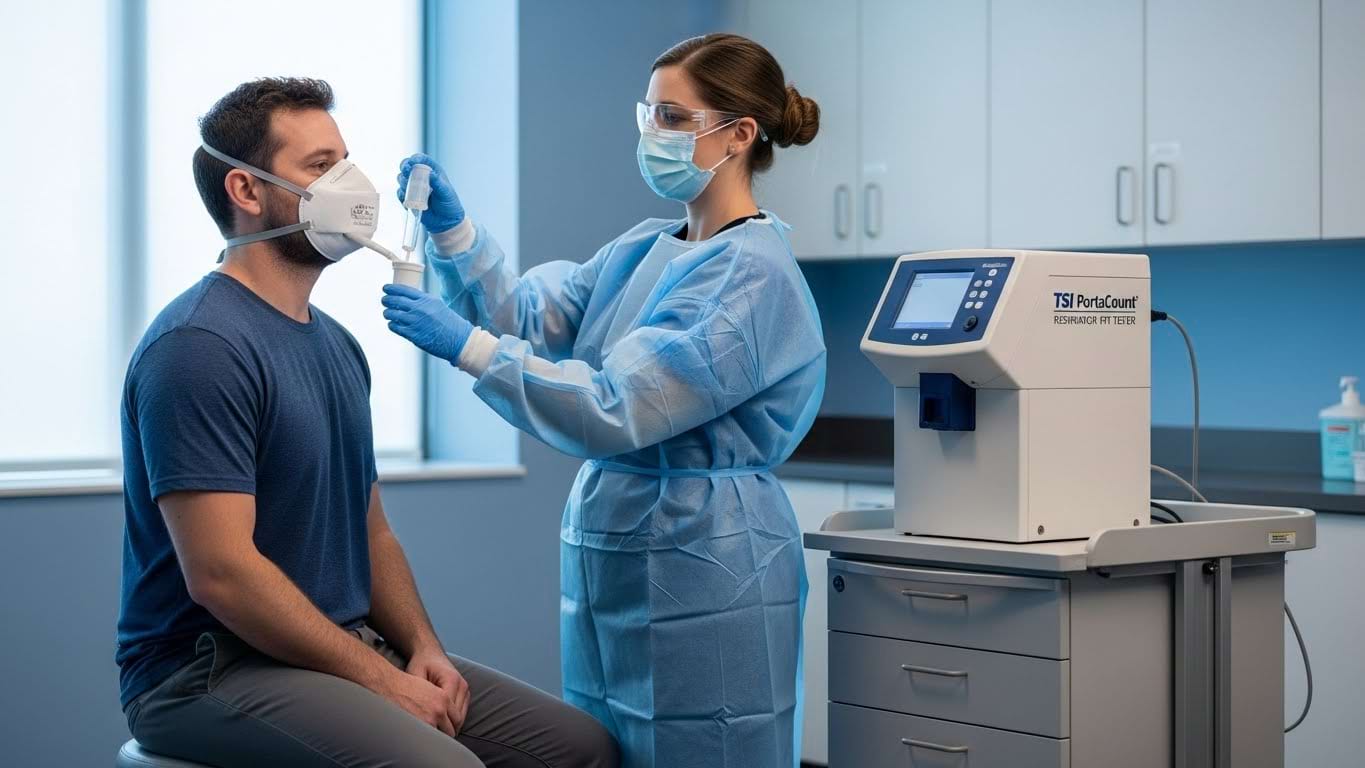
- Uses instrument-based method (e.g., PortaCount).
- Measures actual leakage and provides a fit factor score.
- Requirements for full-face and tight-fitting elastomeric respirators.
Both require the employee to perform movements simulating real work conditions, including: talking, bending, turning, and deep breathing.
Fit Testing Alone Isn’t Enough
Acuity’s seven-step approach streamlines respirator clearance testing for maintaining OSHA compliance:
- Complete the OSHA Respirator (MEQ): A MEQ is required before any fit test.
- Perform a Clinical Review: A qualified HCP determines whether the employee is medically safe to wear a respirator.
- Identify Workplace Respirator: Clear documentation of specific respirator types (N95, half-face, full-face, PAPR).
- Conduct Physical Examination (when indicated): If MEQ responses suggest potential risks.
- Execute Pulmonary Function Testing (when required): Spirometry ensures employees have the lung function necessary for safe respirator use.
- 6. Deliver Fit Testing (QLFT/QNFT): Both types delivered according to OSHA protocols.
- Consolidate Clearance Information: All results, reporting & audit-ready documentation is uploaded to Acuity’s proprietary technology platform, mLink.
This is where many employers lack the administrative resources and capacity to centralize all program requirements.
Common Challenges Employers Face

Even with clear OSHA requirements, many organizations struggle to keep respirator clearance programs running smoothly. The obstacles rarely come from the science of fit testing itself — they stem from operational friction, inconsistent processes, and fragmented oversight. If not addressed proactively, these challenges can hinder the process, create compliance gaps, and increase safety risks.
Scattered Vendors and Recordkeeping Gaps
Manual scheduling, non-standard protocols, and inconsistent clinical reviews create unnecessary delays and audit exposure.
High Test Failure Rates
Most failures result from preventable issues:
- Facial hair in the sealing area
- Incorrect donning
- Safety glasses interfering with the seal
- Wrong size or respirator type
Operational Disruption
Offsite testing disrupts workflows and increases downtime.
Inability to Scale Across Sites
Employers with dispersed workforces spread across multiple facilities, regions, or remote field operations realize cost savings and increased efficiencies using Acuity’s standardized processes and streamlined program management.
Best Practices for a Successful Fit Testing & Clearance Program
A strong respiratory clearance program is built on consistency, preparation, and clear expectations. By applying proven industry best practices, employers can reduce test failures, improve compliance, and minimize downtime. These steps help teams ensure regulatory compliance and maintain a reliable respiratory fit testing and clearance process.
Set expectations early
A clean-shaven policy, PPE compatibility, and pre-test instructions dramatically reduce failures.
Require medical clearance before performing fit testing
Reduces same-day delays, rework, and repeat appointments.
Standardize all testing protocols
Consistent methods reduce variability and strengthen audit outcomes.
Use trigger-based retesting
Removes common compliance gap relying solely on annual
Centralize documentation
Minimizes incomplete or lost records and common audit failure points.

How Acuity International Strengthens Respiratory Protection Programs
Acuity operates one of the most complete respirator clearance and fit-testing programs in the industry, combining:
- Physician-led oversight: Board-certified providers review MEQs, conduct clinical assessments, and ensure OSHA-aligned decisions.
- Mobile & On-Site Testing at Scale: Acuity deploys teams directly to your sites — reducing downtime and accelerating clearance.
- Integrated Fit Testing (QLFT/QNFT): Standardized, OSHA-compliant protocols executed by trained professionals.
- mLink Technology Platform: Real-time dashboards, unified medical records, audit-ready documentation.
- Fit-test first-attempt pass rate: 90–95%.
- Average time to clearance: 5 days.
- National Network of 11,000+ Credentialed Clinicians: Coverage extends to multi-site, remote, and rapid-deployment environments.
- Proven Outcomes: Acuity recently cleared and fit-tested a silica-exposed crew within a tight project window — with all documentation prepared for compliance checks.
See how our Occupational Health services integrate evaluations, surveillance, and workforce readiness into one seamless solution.
Fast FAQ for Employers and Government Agencies

Who requires N95 fit testing?
Any employee using a tight-fitting respirator in a hazardous or regulated environment (healthcare, construction, industrial, emergency response, labs, corrections).
How often is testing required?
Before initial use, annually, and whenever physical or operational changes may impact fit.
Why is medical clearance required first?
Respirators increase breathing resistance; OSHA requires medical evaluation to ensure safe use.
How long does a fit test take?
Typically 10–20 minutes, depending on method.
What causes failure?
Facial hair, incorrect donning, incompatible PPE, or wrong size.
What documentation is required?
Type of respirator, test date, employee identifier, test method, and administrator credentials.
Can Acuity support multi-site or field operations?
Yes. Fit testing is available via mobile teams, onsite clinics, and through our network partners.
Conclusion: A Safer Workforce Begins With a Proper Fit
N95 fit testing is more than a regulatory requirement — it is a foundational step in protecting employee health, reducing risk, and ensuring continuity of operations. When integrated with medical clearance, proper documentation, and ongoing monitoring, it becomes a critical component of your occupational health strategy.
Acuity International helps employers move from fragmented, error-prone processes to a fully integrated, compliant, physician-led respirator clearance program that strengthens workforce readiness and reduces operational friction.
If you’re ready to streamline compliance management, protect your teams, and eliminate avoidable downtime, Acuity is ready to partner with you.